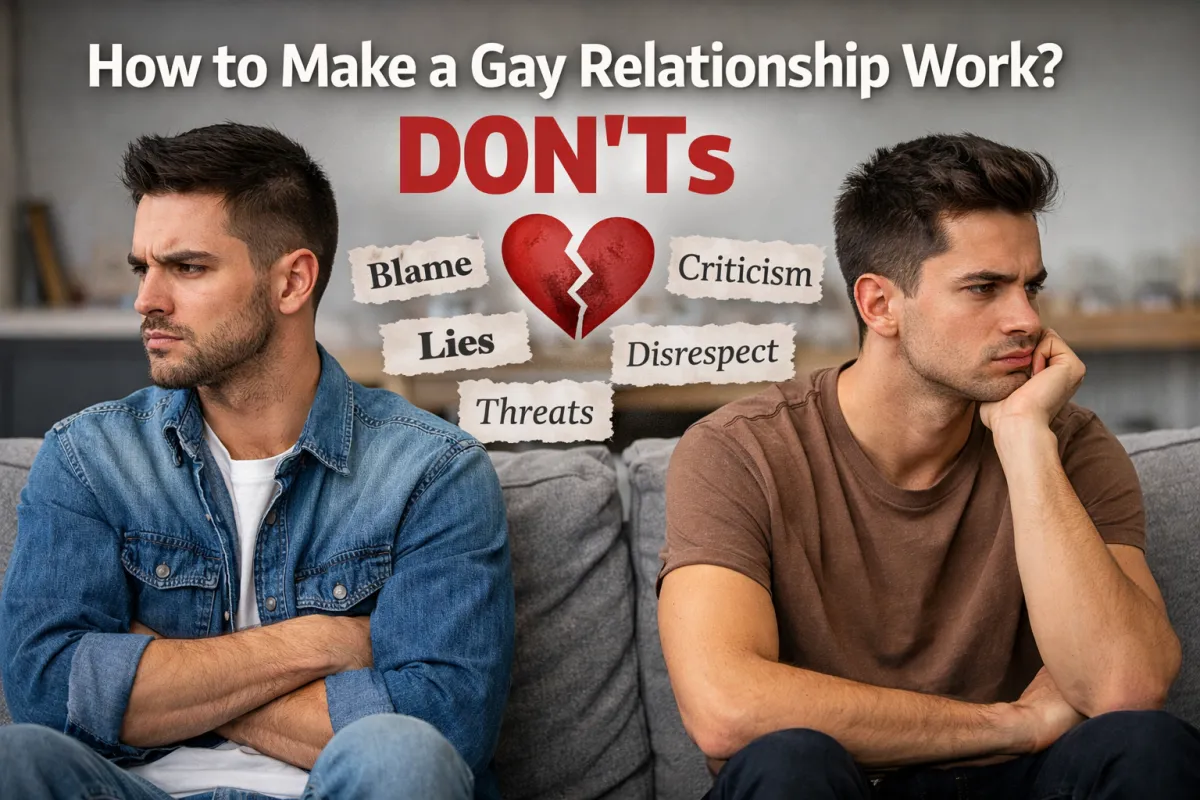
How to Make a Gay Relationship Work: The DON’Ts
Most gay men don’t fail at relationships because they don’t love enough.
They fail because they repeat behaviors that slowly kill safety, attraction, and trust, often without realizing it.
Many of these patterns are normalized in gay dating culture. Some are even mistaken for passion, honesty, or “just how relationships are.” But healthy relationships, especially long-term gay relationships, don’t survive on intensity alone. They survive on emotional safety, respect, and compatibility.
If you want a relationship that actually works, start here: what not to do.
Healthy Relationships Don’t Do That
This section is intentionally blunt. These behaviors don’t mean someone is “bad,” but they do mean the relationship is being slowly undermined.
If you recognize yourself in some of these, that doesn’t disqualify you from love, it gives you a chance to grow.
Insult
Insults, whether sarcastic, playful, or said in anger, leave emotional bruises.
I often hear things like:
“I was just joking.”
“That’s how we talk to each other.”
“He knows I didn’t mean it.”
But your nervous system doesn’t register “jokes”, it registers threat or safety.
In my own past, I used subtle insults as a way to create distance when I felt overwhelmed or insecure. With clients, I see insults used as unconscious power moves: a way to feel less vulnerable.
Healthy relationships don’t erode self worth to regulate emotions.
Blame
Blame is what happens when accountability feels too threatening.
Instead of:
“I felt disconnected and didn’t know how to ask for closeness.”
It becomes:
“You’re emotionally unavailable.”
Blame keeps both partners stuck. One feels attacked, the other feels righteous. No one feels understood.
In coaching, once blame is replaced with self responsibility, intimacy usually returns surprisingly fast.
Compete
Competing over who:
is more emotionally evolved
works harder
earns more
sacrifices more
has more trauma
…turns a relationship into a scoreboard.
I’ve seen couples where love turned into quiet resentment because everything became a comparison. One client said, “I felt like I had to lose for him to feel okay.”
Healthy relationships are collaborative, not hierarchical.
Distrust
Distrust doesn’t always look like jealousy.
Sometimes it shows up as checking tone, overanalyzing delays in replies, assuming hidden motives, or expecting disappointment.
Gay men often carry relational hypervigilance due to past rejection, secrecy, or abandonment. But distrust creates the very distance it fears.
Trust isn’t certainty. It’s the willingness to tolerate uncertainty without control.
Resent
Resentment is unspoken anger that has nowhere to go.
It builds when needs are minimized, delayed or repeatedly unmet.
In my experience, resentment doesn’t come from asking for too much, it comes from not asking clearly, or staying when your needs aren’t honored.
Healthy relationships address tension early. They don’t let it fossilize.
Deny
Denial looks like:
“It’s not a big deal.” “I’m over it.” “This doesn’t bother me.”
When something does bother you.
I’ve denied my own needs in the past to avoid conflict, only to later feel disconnected and cold. Many gay men learned early that having needs was unsafe, so denial became survival.
But denial doesn’t create peace. It creates emotional distance.
Threat
Threats include:
“Maybe we should just break up.”
“I don’t know if I can do this anymore.”
Or silent withdrawal meant to scare the other person
I’ll be honest: I’ve used this in the past as a way to regulate anxiety when I didn’t know how to ask for reassurance.
Threats don’t build security, they destroy it.
Healthy relationships don’t weaponize abandonment.
Disrespect
Disrespect isn’t only yelling or name calling.
It can be dismissing feelings, eye rolling, talking about your partner instead of to them, or violating agreed boundaries.
Respect is the foundation of attraction. Once it’s gone, chemistry usually follows.
Hold Grudges
Grudges are frozen conflict.
They signal unresolved hurt, unmet repair, or lack of emotional closure.
I often tell clients: if you’re bringing the past into every disagreement, the wound was never healed.
Healthy relationships repair fully or they don’t continue pretending.
Criticize
Criticism targets character, not behavior.
“You’re selfish.”
“You’re impossible.”
“You always ruin things.”
Many gay men internalized criticism early, from family, society, religion. Recreating it in relationships retraumatizes the nervous system.
Feedback builds closeness. Criticism builds walls.
Keep Secrets
Secrets create asymmetry.
Whether it’s money, communication with an ex, resentment, or emotional withdrawal
Secrets force intimacy to operate on incomplete information.
Healthy relationships don’t require total transparency, but they do require integrity.
Demand
Demands are needs wrapped in fear.
“You have to…”
“If you don’t, then…”
Demands trigger resistance. Requests invite connection.
The shift from demanding to requesting is one of the biggest transformations I see in coaching work.
Ridicule
Ridicule is contempt, and contempt is the fastest predictor of relationship breakdown.
Mocking vulnerability, emotions, or sensitivity shuts down trust instantly.
Healthy relationships protect vulnerability. They don’t punish it.
Abuse
Abuse, emotional, verbal, psychological, or physical, is never justified.
Love doesn’t heal abuse. Understanding doesn’t excuse it. Patience doesn’t transform it.
If abuse is present, the work isn’t “communication”, it’s safety and boundaries.
When a Gay Relationship Just Doesn’t “Work”
Not every relationship fails because someone did something wrong.
Sometimes, two good people are simply incompatible.
In gay relationships, incompatibility is often mislabeled as:
“I need to try harder”
“I’m scared of intimacy”
“I’m self-sabotaging again”
But forcing a connection that lacks emotional alignment creates exhaustion not growth.
I’ve worked with clients who stayed years trying to fix something that was never broken, just misaligned.
If you constantly feel:
tense instead of safe
confused instead of clear
obligated instead of chosen
…it may not be fear. It may be truth.
Too Needy, or Too Neglected?
This is one of the most misunderstood dynamics in gay relationships.
Someone labeled “needy” is often:
emotionally aware
craving consistency
responding to intermittent closeness
Someone labeled “emotionally unavailable” is often:
overwhelmed
avoidant
afraid of dependency
In my own experience, and in countless client cases, neediness often disappears in the presence of emotional availability.
The real question isn’t:
“Am I too much?”
It’s:
“Is this relationship meeting my core emotional needs?”
Healthy relationships don’t require shrinking or chasing.
What Actually Makes a Gay Relationship Work: Final Thoughts
A healthy gay relationship isn’t perfect.
But it is emotionally safe.
It doesn’t rely on fear, intensity, or endurance.
It relies on respect, clarity, and mutual willingness.
If this article stirred something in you, confusion, recognition, or relief, that’s not random. Awareness is the first step toward change.
Ready for clarity?
If you’re questioning your relationship, dating patterns, or emotional availability and want honest, grounded guidance, I offer a free 1:1 clarity call.
We’ll look at:
what’s actually happening (not just the story)
whether this is growth or misalignment
and what your next step truly is
You don’t need to force love to make it work.
You need the right conditions for it to grow.
If this article resonated, you don’t have to figure this out alone.
Or book a free clarity call with me to explore how to break this cycle


